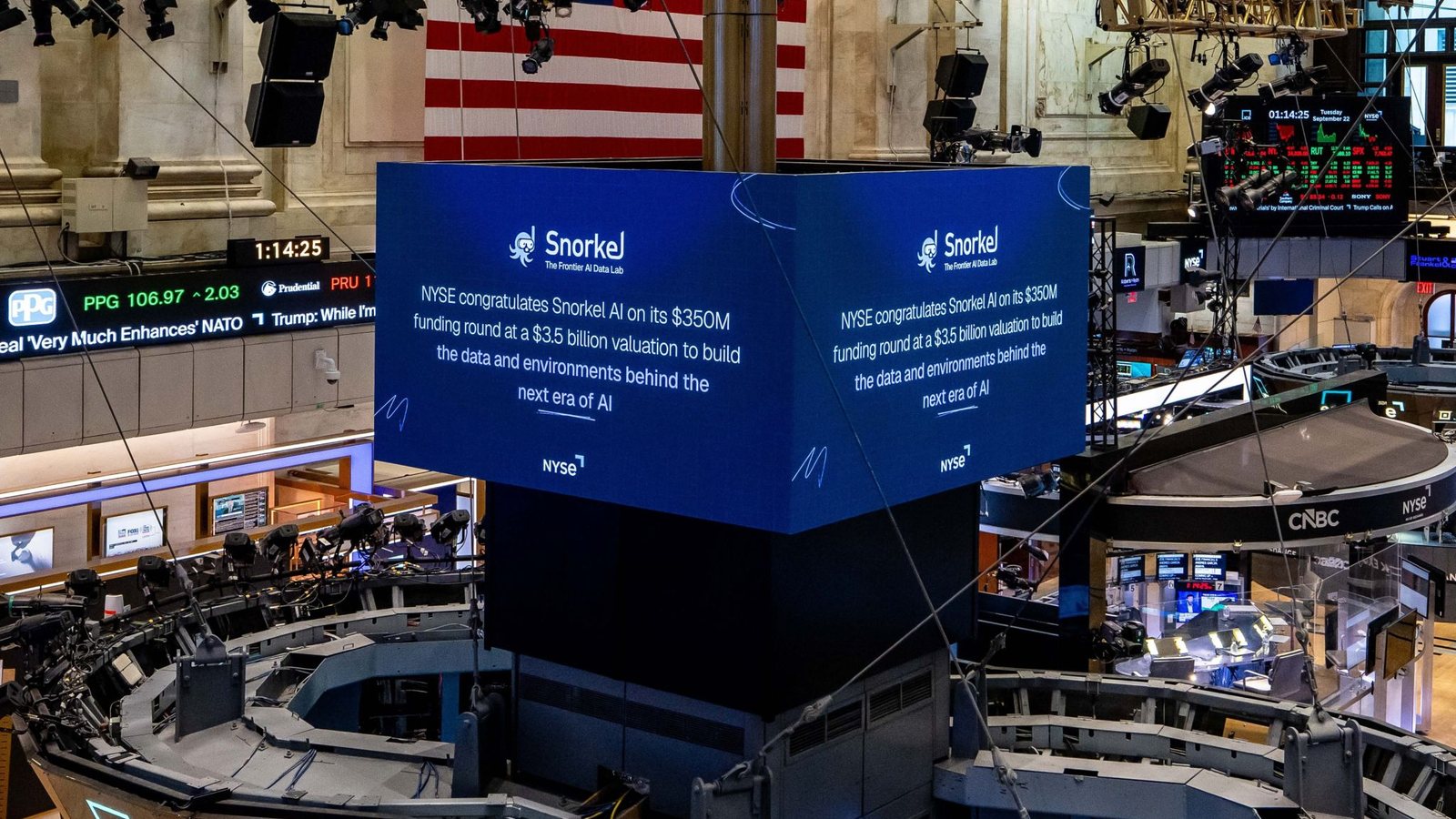
Snorkel AI has announced a $350 million Series E at a $3.5 billion valuation. Co-founder and chief executive Alex Ratner says its data-as-a-service business has grown more than 18-fold since launch and crossed a $375 million annualized revenue run rate as demand grows for complex data that can train and test advanced AI systems.
Those are company-reported figures. An annualized run rate extrapolates recent performance and should not be read as booked annual revenue.
From Data 1.0 to Data 2.0
Ratner calls the earlier phase Data 1.0: producing large volumes of relatively simple training data, with staffing and logistics central to the work. He argues that more capable models increasingly need carefully chosen tasks that expose what they still cannot do. He calls this next phase Data 2.0.
In that model, value shifts from sheer volume toward extremely complex, precisely targeted data and realistic evaluation environments. The company points to coding tasks that can span days of senior engineering work, capture subtle product goals and detect when an AI agent tries to game the test. Ratner says similar demands extend to legal, finance and biology.
“The frontier ahead will be driven by research-driven approaches combining the best of human expertise and AI acceleration.”
Alex Ratner, co-founder and CEO, Snorkel AI
What changes for human experts
For expert human data workers, the thesis points toward designing realistic scenarios, evaluation environments and grading rubrics rather than simply supplying more labels. Specialists define what good performance looks like, identify failure modes and exercise judgment over outputs that generic automated checks may miss.
Snorkel’s bet is that AI tools can expand expert-written seeds, guide contributors toward model error modes, provide live feedback and run quality-control checks. Human review then improves those specialist systems in a continuing loop. The company argues that this combination can keep people at the centre of model evaluation even as the technical difficulty of frontier data rises.
The market signal — and the caveat
A $350 million financing at a $3.5 billion valuation is a significant vote of confidence in the idea that data development is becoming a research and technology market, not only a staffing market. It also adds Snorkel to a group of rapidly valued companies competing to organise expert knowledge for frontier laboratories and enterprise AI teams.
Funding and reported growth do not, by themselves, establish that every human data role is moving in the same direction. Snorkel’s figures and its Data 2.0 framework come from the company’s own announcement. The durable test will be whether customers continue paying for higher-complexity environments and whether expert-plus-AI production systems deliver measurable gains in model capability, safety and evaluation quality.
Snorkel is betting that the next AI data bottleneck is not a shortage of labels, but a shortage of expert-built tests that advanced models cannot easily pass or exploit. Its new financing gives the company substantial capital to prove that market exists at scale.