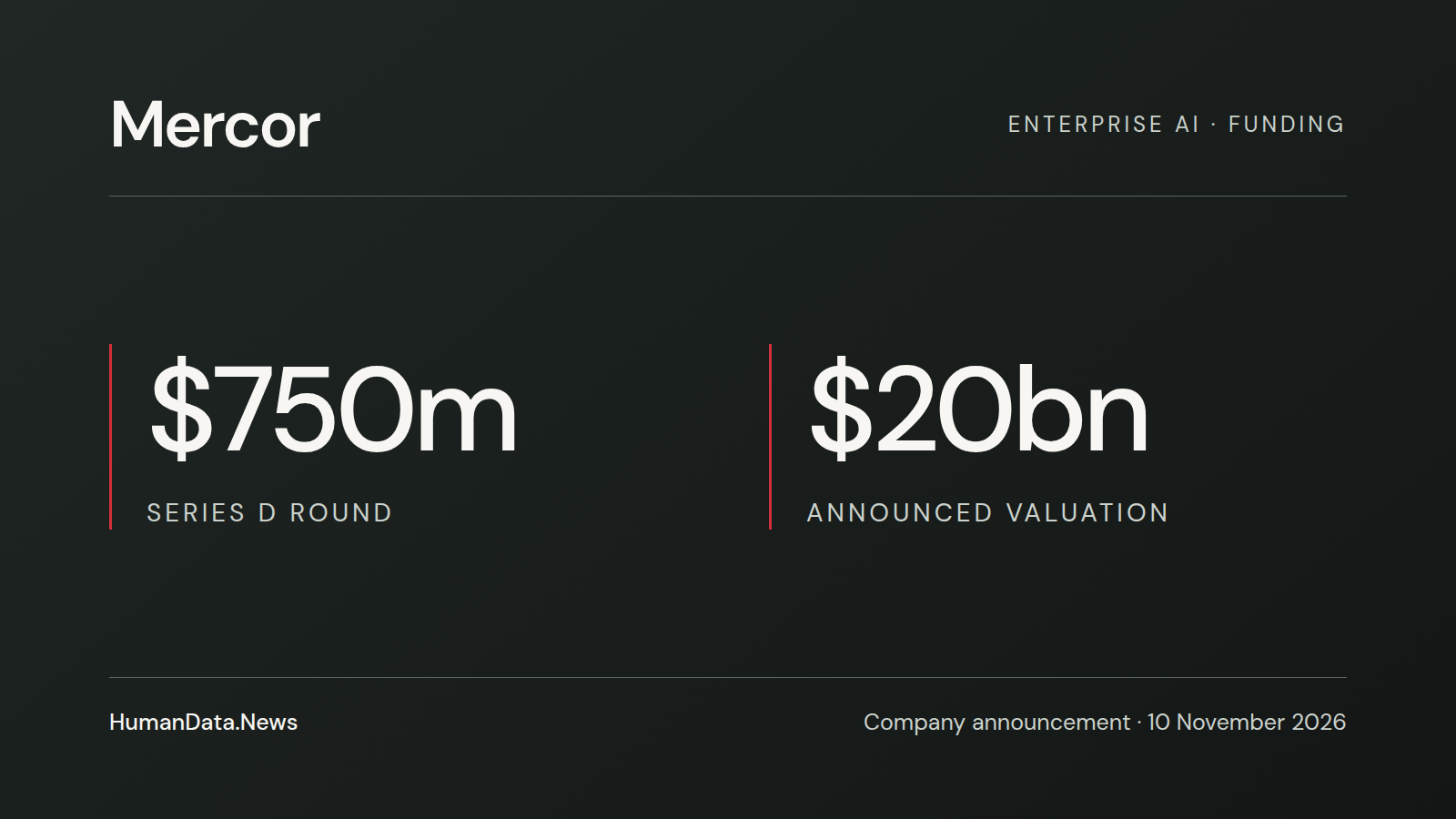
Mercor has announced a $750 million Series D funding round at a $20 billion valuation, doubling the valuation attached to its previous round as it expands its work training and evaluating AI agents.
The announcement, made on 10 November and reported by Reuters, names investors including Benchmark, Felicis, Fundomo, NVIDIA and funds managed by affiliates of Apollo.
Mercor’s own announcement says the round included an employee tender. It does not disclose the split between primary funding and employee share sales.
The company previously announced a $350 million Series C at a $10 billion valuation on 27 October 2025. That announcement already described professionals turning workflows into evaluations, making the latest round an expansion of an existing direction.
Mercor says the new funding will support evaluation research, post-training infrastructure and environments in which agents can practise complex workflows. It describes extending capabilities developed for frontier laboratories to enterprise customers.
Its approach includes custom evaluations based on a company’s actual work, testing agents against that organisation’s requirements. The announcement also points to its earlier acquisition of Deeptune, which recreated enterprise applications for agent training.
Why it matters for the human-data market
Human Data Solutions’ reading is that Mercor is positioning itself to serve a broader part of the enterprise AI development process: identifying what successful work looks like, measuring an agent’s performance and supplying the expertise needed to improve it.
For human-data experts, that creates a practical distinction between knowing a subject and being able to turn professional experience into a testable workflow. A marketing specialist, for example, could contribute a campaign-planning task with explicit constraints, evidence requirements and criteria for judging the result. That is an illustration of the potential work, rather than an announced Mercor vacancy.
The funding announcement does not establish that contractor rates, project availability or individual earnings will increase. Those outcomes depend on the projects commissioned and how the work is allocated.
For buyers, a useful question will be whether these evaluations predict performance in everyday operations. For experts, it will be whether their ability to define tasks, assess decisions and explain failures translates into sustained paid work.
The valuation marks a further increase in Mercor’s financing scale. Its significance for the wider human-data economy will become clearer through the enterprise projects and expert opportunities that follow.